Mostrando entradas con la etiqueta 2nd ESO. Mostrar todas las entradas

miércoles, 5 de mayo de 2021

WINTER LANDSCAPE PAINTINGS IN 16th-17th CENTURY EUROPE AND THE LITTLE ICE AGE

 Shared by Sonia Rodríguez:

For the task 4 I have chosen a cross-curricular project that involves Art History, Geography,  Science and Plastic and Visual Education.

It is aimed at students of 2nd year of ESO, for the subject of Geography and History.

It consists in the analysis of 16th and 17th century winter landscapes and the research about their relationship to the Little Ice Age in Europe.

When studying  Renaissance art, we see the first depictions of  landscapes, that will become very popular during  the baroque period.  A specific type of landscape is the winter landscape, especially popular in Dutch and Flemish paintings.

First, we analyse the painting of Pieter Bruegel the Elder, “Hunters in the Snow” (1565).  Then we see other paintings depicting this topic , which was a common one during this period. 


After that, they must find out what the weather is like in those places today, and the reason for the Little Ice Age.


Finally, they are asked to design their own 17th century style winter landscape drawing with a short explanatory text. The drawings will be displayed in the classrooom.


ACTIVITIES

û  Find out what  London Frost Fairs were, and during what period they were held.

û  Does the Thames river freeze nowadays? Find out what the weather  is like currently in London, and if those fairs would be possible. What happened in that time, then?

û  Explain what was the Little Ice Age, and its causes.

û  Would you like to experience that type of winter? Why?

û  Now, MAKE YOUR OWN DRAWING DEPICTING A 17th CENTURY WINTER LANDSCAPE WITH A SHORT TEXT explaining the image and summarising the causes of that kind of weather in Europe.

jueves, 15 de abril de 2021

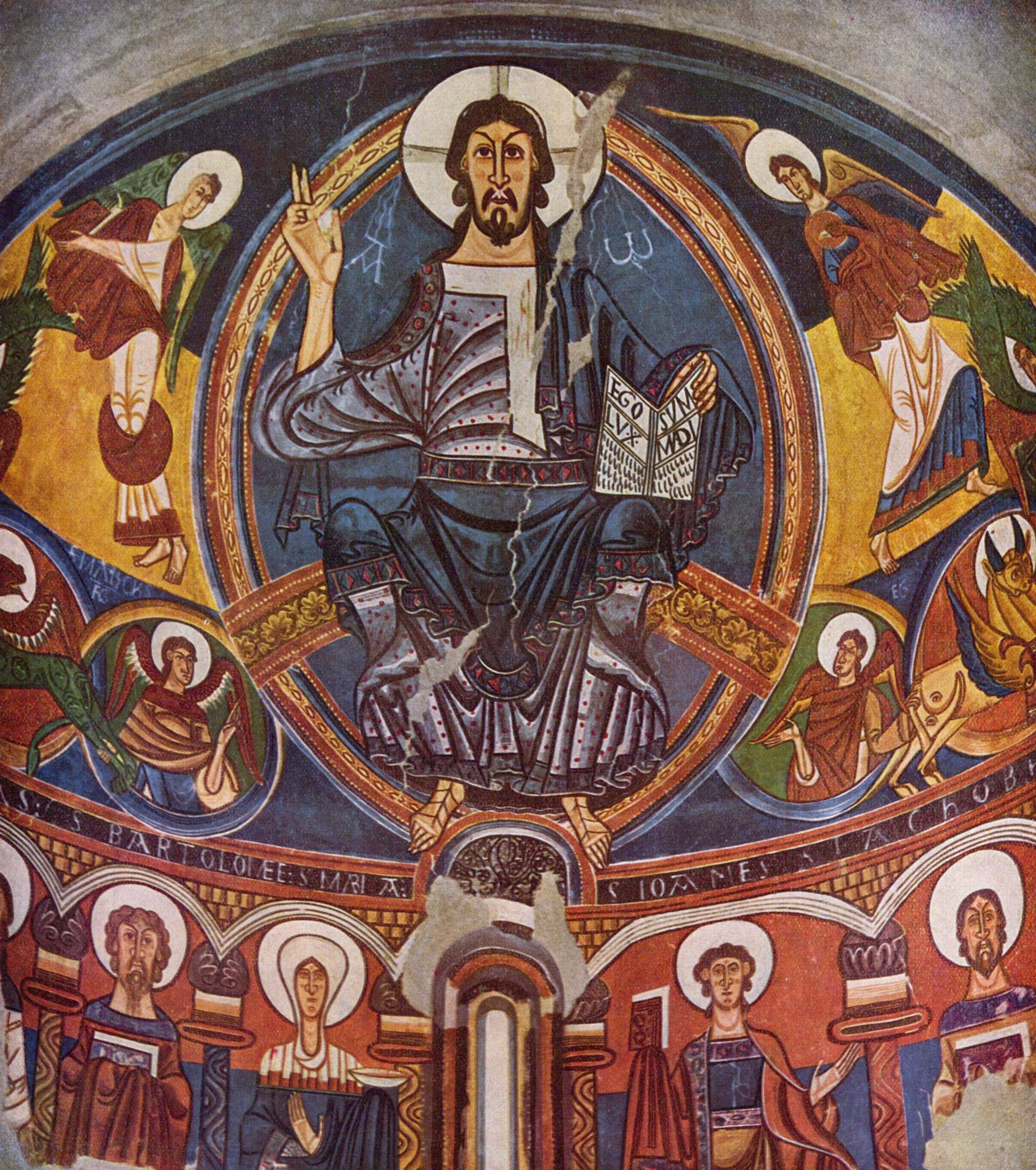
The Pantocrator in Saint Climent of Tahul and Mystery's House in Pompeii

                                            https://upload.wikimedia.org/wikipedia/commons/e/ed/Meister_aus_Tahull_001.jpg

Shared by Rebeca de Paz:

My task is for 2nd of ESO History class. We are going to talk about art in Middle Ages, specifically in Feudalism Era, so we will study Romanesque style. 

It is going to be the first time for them studying art since last course, 1st of ESO, so we´re going to do an introduction to art in these ages. The last art they have seen was Roman, that-s why I have chosen a roman piece of art and a Romanesque painting. The two pieces of art are: a fresco in Mystery’s House in Pompeii, and  a Spanish fresco in Saint Climent of Tahull, in particular the great Pantocrator.

The aim of this exercise is not only the study of the art, but the mentalities as well. The have to notice the change between the Roman lives, more sophisticated y thriving, whereas in the Middle Ages, everything looks like a new beginning, as if they have forgotten everything people achieved centuries before.

Regarding the art, we need students to understand the different purpose of the art in both ages, while in the Roman Empire art is for enjoyment, Romanesque style has an obvious aim: understand the religion.  

We will ask the students the similarities and differences that they see in the painting, such as the theme, colour, perspective or the features of the characters that appear. 

We want them to realize that while in the Empire what is naturalism is taken care of, that the models resemble reality, with mythological themes referring to their religion, with Christian painting we see how everything that is aesthetic is lost to give importance to the message, which in this case is the indoctrination and understanding of the bases of religion for a totally illiterate population. 

The container does not matter if not the content, so it does not matter that that Christ in Majesty has little expression nor has disproportion, so what matters is what that Christ judge, the beginning and the end of everything, means.

I would do this activity at the beginning of the didactic unit related with medieval art: Romanesque and Gothic styles. This activity gives me as a teacher the opportunity to start an evolution of the art, rescuing educational contents of the previous year, and they can understand History is not compartmentalized but it is a constant evolution.


miércoles, 14 de abril de 2021

Photographies by Elliot Erwitts and Angelica Dass

 Shared by Miriam García:

COMPARATIVES  

                     Photograph: Elliott Erwitt’s Bridgehampton New York, 1990

Students will be asked the following questions:
1. What do you see in this photograph?
2. Can you compare the girl and the man? They will have to do comparisons of equality, superiority and inferiority.
3. Do you like this photograph? Why?


SUPERLATIVES

Activity 1  Photograph: Elliott Erwitt’s New York City, 1974


Students will be asked the following questions:
1. What can you see in this photograph?
2. Use superlative adjectives to compare the following elements:
- Legs
- Ears
- Head
- Speed
3. Do you like this photograph? Why?


Activity 2  

              Photograph: Robert Doisneau’s Information Scolaire, Paris 1956

Students will be asked the following questions:
1. What can you see in this photograph?
2. Use superlative adjectives to talk about the following kids:
- The cheater
- The hard-working
- The thoughtful
- The
3. Do you like this photograph? Why?


Activity 3  
Project: Angelica Dass’s Humanae

Students will be asked the following questions:
1. What can you see in this photograph?
2. Use superlative adjectives to talk about the people regarding their…
- Age
- Hair
- Skin
3. What do you think about this project?                                                             
 Get to know about it: https://angelicadass.com/photography/humanae                                  What is its main goal? 

https://fotogasteiz.com/wp-content/uploads/2019/12/angelica-dass-pantone-1024x683.jpg

lunes, 12 de abril de 2021

Bedroom in Arles by Vincent Van Gogh


Shared by Laura Vega:

I have chosen "Bedroom in Arles" by V. Van Gogh to explain the different prepositions of place in English.


The lesson will start with the display of the picture to the students during a couple of minutes and the request of telling what impressions of the picture they have (comfort, strain, childish, etc.)

Then, I will teach them some prepositions of place such as "behind", "next to" or "above" and I will ask them to write them on their notebooks (to review later).

The next step is that the students work in pairs, and one of the them in each pair, and now without looking at the picture, tries to describe the room to his/her mate. The latter will have to draw what he/she is being depicted.

When they finish (describing and drawing), they will compare their productions with the original painting and they will have to comment on the possible differences.
I can assign a prize to the pair which has committed less mistakes.

To finish, I will provide them with a short and easy biography of Vincent Van Gogh and we will read it in class, in order for them to know more about the life of the painter.

jueves, 8 de abril de 2021

The surrender of Granada, by Francisco Pradilla y Ortiz


Shared by Mª del Camino Berciano:

We have to study the Catholic Kings on second grade (ESO). 

This picture represents the surrender of Granada by Boabdil. We can use this picture to practise:

-vocabulary related with this theme. 

-Elements of the countryside, Granada and the Alhambra. 

-Diferences between the armies: weapons and armours. 

We can analize and explain the Symbols of power. 

We can review the differents Attitudes and feelings of the differents characters. 

We can study the structure of the picture, perspective and distribution of the characters. 

We can explain the historical situation and the consecuences of this image.

miércoles, 7 de abril de 2021

The Golden Lady, by Gustav Klint


Shared by Sara Acebes:

 I have chosen "The Golden Lady" by Gustav Klint. The aim of this activity is to make students speak about a painting and use vocabulary related to the senses, shapes, the appearance and also to learn about the situation of Jewish people during the Word War II. 
I have divided the activitiy into two parts.

In the first part the students have to talk about the picture using the following questions:

PART ONE:
Look at the painting.
What can you see when you first look at it? Write down the first words that come to your mind.
Look at it again.

• What geometrical shapes can you see in the picture?
• What is the predominant colour?
• Can you describe the woman?
• What do you think she is looking at?
• What is she thinking about?
• What is she wearing?
• Where is she?
• How do you feel when you look at the painting?
• How would you title it?
• In our opinion, when was it painted?

PART TWO:
The second part is a writing activity: the students have to choose one of the two options:

Choose one of the two options:
1. You are the woman in the painting ,think about her life, her likes, her name, her family, her routines.

2. Make up a story about the woman in the picture.
As an optional activity the students can read the story behind the picture and also watch the film "The Golden Lady". Read the story here.


Sara also shares two of her students' compositions:

 Esther2ºB

Elisa, 2ºB


martes, 6 de abril de 2021

The Kiss by Constantin Brancusi


Shared by Alexandra Bedelean:

Name of the activity: Describe the sculpture "The Kiss"


Development: Taking into account the name of the sculpture it could be used as a complementary activity for Valentine's Day. Nevertheless, it could be introduced when taking about relationships. 

Begin with some explanation about the author of the sculpture, Constantin Brâncuși. 
Make the students guess his nationality and encourage them to pronounce his name. 
Ask them to describe the sculpture. Prompt some questions: 

What does it represent?/It represents/ It shows...., 
What is it made of? 
What tools do we need to make a sculpture?

With these simple questions they learn vocabulary of materials (stone, marble), tools (chisel, hammer, rasp grinder), colours (beige, nude, ivory...), body parts. 

Make sure they use words like: hug, wrap, symmetry.

With stronger groups suggest wordbuilding to enrich their vocabulary: together - togetherness, love - lovers. They may approach the philosophical idea of love and the missing ears which leads to the forgetfulness about the world (a characteristic of teenagers when they fall in love). 

With the same strong groups debate about the danger of the lovers' forgetfulness about the world and the danger of the world forgetting about love.

Describing and drawing Van Gogh


Shared by Judit Carnero:

This activity is designed for a 2nd year of ESO, but if we adapt it properly we could use it in any other class. 

The activity begins by separating the class into groups of 2 or 3 people. One of the members will be given the image of the selected painting. 

Their task will be to describe that image using ‘there is, there are’ to the partner or partners in that group. 

Meanwhile, they should draw in their notebooks what their partner tells them about the painting. At the end of the description, the two students who have been drawing should compare their drawings with each other, paying special attention to the differences that exist between the two images. 

Finally, the student who has made the description will show the image to the other classmates and together they will do a brief analysis of the differences between the images. 

In this way, students will be able not only to practice the use of “there is / are”, but also vocabulary related to certain topics, depending on the picture chosen. 

The use that we could give to prepositions of place is also very important, as students have to describe the situation or location of different elements in the picture.

Spring Haiku poems


Shared by Raquel Calleja:

My students 1st and 2nd ESO students will write Haikus in spring. I also made this activity with a PMAR class.

They will be given the instructions explained in detail in the attached web. They will learn what a haiku is first moving them to write a haiku being inspired by famous works of art. In the end we will make a poster with all the haikus.

In this link you can access to this acitivity planned step by step:

This video shows how to make the reading bookmark: 

*Suggestion: students can dub this video into English using Edpuzzle, for instance).

In these ones they can see how to write their names in Japanese:

https://japonesbasico.com/como-escribir-tu-nombre-en-japones/


Here you can see some of the bookmarks and the decorated chopsticks:


______________________

Another bookmark using a Hiroshige painting promoting the Spanish edition of a Japanese novel:


lunes, 15 de marzo de 2021

The Problem We All Live With by Norman Rockwell


Shared by Mª del Prado Sobrino:

A comic strip based on Norman Rockwell´s painting called The Problem We All Live With, 1964.


Being able to describe what is happening is an essential part of learning a new language and vocabulary building. 

This art activity is perfect for students of all ages to. This activity is a great way for students to use their artistic talents and practice using descriptive words and telling a story in an engaging way. Analyzing narrative art teaches students how to observe and think critically about the world around them. It also gives the teacher a great opportunity to assess their speaking skills and sentence construction abilities.

Materials:1 sheet of A4 paper for each student. Coloured pencils, crayons, markers and drawing pencils

Instructions:

It involves getting your students to draw a comic book strip about what happened in the picture and imagine why this is happening and what is going to happen after that.

1º: First the students have to analyze the image and discuss it with their classmates. They have to start describing what they see using the present continuous tense. Present any new vocabulary they will need to know.

To encourage your student to talk you can ask:

-What is happening in the image? What is the meaning or the word “nigger” painted on the wall?
What is the little girl doing? What is she thinking about? What does she want?
-What are the people who threw the tomatoes thinking? What do they want?
- What are the men in uniforms thinking? What are they doing?

2º. Next, they have to hypothesize way they think this is happening. They can use the past tense here. After that they have to imagine what is going to happen. Once everything seems clear and they have understood the task, let them loose to draw their own comic telling the entire history they have just invented.

3º. In the next class you can ask your students to present their comic strip to the class and explain, using the new vocabulary, what is happening in each scene.

4º. Finally, you can watch this video of Ruby Bridges (as shown above) , the little girl in the picture, many years later talking to President Obama. 

After watching the video explain that this painting was made in America in 1964, during a time of political and social upheaval. The name of the girl is Ruby Bridges and she is a six year old African American girl walking to school in an all-white public school system in New Orleans on November 14th, 1960.


Primera y segunda ponencias del curso

Primera y segunda ponencias del curso

       EMBELLISH YOUR ENGLISH LESSON WITH ART. SECONDARY Click on   the image above to access to the contents of the first session of the c...