Mostrando entradas con la etiqueta TECHNOLOGY-ICT. Mostrar todas las entradas

martes, 4 de julio de 2023

Art in AI-motion: a mini lesson using Artificial Techology


I have designed a mini lesson meant to be an interdisciplinary lesson among English, Music, Visual Arts and Technology using IA support. You will find that it can easity be adapted to any level.

The lesson deals with emotions, shapes, music  and the artistic experience through the works of Vassily Kandinsky. The lesson includes the use of  different Artificial Intelligence apps, free and really easy to use: Music Lab, google Arts, Mentimeter or Genially.

You can find the mini lesson attached and I hope you can use, adapt o inspire you.  

Clilck on the picture or in the link to access to the full lesson.

Shared and curated by Mariví de la Rocha


domingo, 9 de mayo de 2021

Download and 3D print 18,000 famous sculptures and artifacts from museums all over the world


From upper-left corner, clockwise: lamassu of ancient Assyra; the Lewis chessmen; 18th-century vase; bust of Nefertiti. All scans available to download on Scan the World.


Source: Madeleine Muzdakis for My Modern MET

The world's grand museums—such as the Louvre and the Metropolitan Museum of Art—present sculpture to the masses. Ancient marble and modern bronzes are placed in vaulted halls and beautiful gardens so that guests can admire them. The digital developments of the past decade are now bringing the world of famous sculpture to you. If you have access to a 3D printer, you can download and create over 18,000 sculptures and artifacts from around the world thanks to the Scan the World collection on 3D-printing collaborative platform My Mini Factory.

Scan the World is an open-source collection of detailed scans taken of real-life works of art from all across the globe. These scans are downloadable and can be used to 3D-print your own mini masterpieces. An ongoing project by both art lovers and the 3D-printing community, Scan the World has partnered with Google Arts & Culture to acquire scans from museum collections around the world. For some works of art that are publicly displayed or difficult to reach, drones have been used to scan the object.

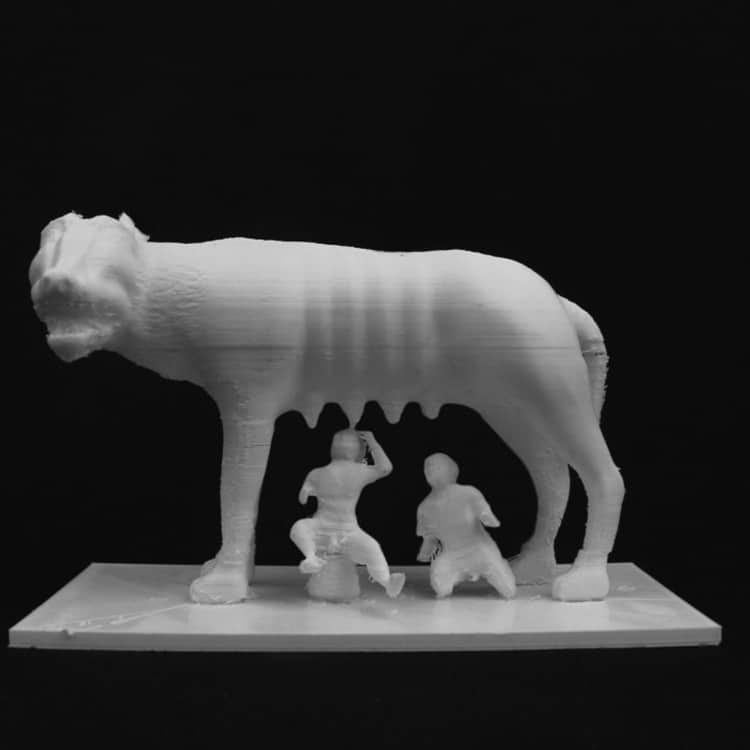
Included among the thousands of scans are ancient artifacts—such as an Egyptian fish flask, ancient stela with inscriptions, and even the legendary bust of Nefertiti (which can be found at the Neues Museum, Berlin). You will also find works of sculpture stretching from ancient Roman busts to modern abstract creations. Among the famous works you can download and print are Michelangelo's La Pietà, Rodin‘s The Thinker, and The Capitoline Wolf (which shows a young Romulus and Remus, founders of Rome).

The Lewis Chessmen at The National Museum of Scotland. (Photo: Scan the World, CC BY-NC-SA 4.0)

The possibilities are endless while exploring Scan the World. Search by artist, artwork title, or popularity. Scan the World also hosts virtual visits to Paris and Vienna which can satisfy any travel lust. While 3D-printing technology is making huge advancements in the medical fields and offering creative solutions to some of the world's more challenging material science problems, Scan the World proves that the technology can also help bring an interactive art experience to a wide audience.

The Capitoline Wolf at The Musei Capitolini, Rome. (Photo: Scan the World, CC BY-NC-SA 4.0)

The project Scan the World has collaborated with Google Arts & Culture and countless museums to collect over 18,000 scans of artwork, artifacts, and statues from around the world.


La Pietà by Michelangelo. (Photo: SMK – Statens Museum for Kunst, Public domain)

These scans can be downloaded and 3D-printed to make scale models of world-famous art, including Michelangelo's La Pietà.


Bust of Nefertiti at the Neues Museum, Berlin. (Photo: Scan the World, Public domain)


An open-source project, the scans include a bust of Nefertiti and other ancient artifacts.

The Thinker at the Musée Rodin, France. (Photo: Musée Rodin, CC BY-NC-SA 4.0)


What would you print?


jueves, 8 de abril de 2021

Interior of the Pantheon in Rome” by Giovanni Paolo


MAN-MADE STRUCTURES AND STRUCTURAL ELEMENTS


Shared by Mª del Mar Mañanes:

The work of art “Interior of the Pantheon in Rome” by Giovanni Paolo Panini will be used to introduce the topic of structures types and structural elements in technology. 

We will focus also our work in the uses of the different tenses – past present and future – to explain how buildings were made in the past, how they are made nowadays and how students think they will be made in the future.

Warming (activity 0):

Students will start by answering the following questions about the work of art chosen:

- What kind of structure can you see in the picture? 
  A vaulted structure

- What different elements can you see on the picture? Try to locate them in it.
Arches, vaults, columns, dome,…

- Why do you think they used these structures?

The Romans used round arches to build bridges and aqueducts and they used barrel vaults and domes to cover basilicas and pantheons. With arches and vaults, builders could cover larger spaces and have bigger gaps in the structures. Vaulted structures are formed by arches and vaults using stones that are cut in such a way that the only stress they support is compression – no problem for hard stone.

Activity 1:

Students will be divided into eight groups and each group will study a different type of structure:

1. Solid and lintel
2. Vaulted structures
3. Triangular structures
4. Suspended structures
5. Reinforced concrete structures
6. Laminated structures
7. Pneumatic structures
8. Spatial and geodesic structures

They have to look for a picture of a building which is an example of this type of structure, and they have to find out, among the vocabulary learned in the unit, the structural elements used in each type of structure (column, arch, vault, beam, buttress, foundation, cable, suspender…). They have to upload the results of their researches in the class blog.

They will ask and answer the following question in pairs:

- What type of structures were used in the past? 

- How do you think structures were built in the past (Egypt pyramids or roman temples for example)?

- What type of structures are used nowadays? How do you think we built structures now? Does technology help?

- What type of structures do you think will be used in the future? 

- How do you think they will be built then? 

- Will technology be important in the future constructions?

martes, 9 de marzo de 2021

Wandering above the Sea of Fog or above the Sea of Trash?


Shared by Soraya Paniagua:

It is an activity that combines several transversal themes: art and the environment, it is about applying in the classroom an activity similar to that of making memes, but instead of using an application that generates them, it is about doing the photographic retouching directly with suitable software on known artistic works to make a social complaint. 

Tools that can be used for free: Photoshop Expres, PhotoScape, Picsart, SumoPaint, BeFunky, iPiccy, piZap, Microsoft Paint, Pinta, Paint.NET, GIMP, Pixlr, Krita, Photo Pos Pro, Fotor, etc. 

In this case, the attached example of a version of the painting "Wanderer above the Sea of Fog" (1818, Caspar David Friedrich), in which the excessive amount of waste and the lack of awareness in the care of the planet is criticized. 

Wanderer above the Sea of Trash, by Liis Roden, 2021.

Thus, based on this work of art, I can propose an activity in ICT class in which interesting current topics can be discussed. 

This activity can be carried out individually, in pairs or in group, depending on the circumstances. There would be a plenary to exhibit the new versions and the works will be exhibited.


https://www.artble.com/artists/caspar_david_friedrich/paintings/wanderer_above_the_sea_of_fog

https://www.pinterest.es/pin/644929609137724477/

lunes, 8 de marzo de 2021

Wood and technological materials with "Christ in the House of His Parents" by Sir John Everett Millais


Shared by Teresa de los Bueis:

I would use the painting "Christ in the House of His Parents" by Sir John Everett Millais to be used as a revision exercise at the end of the unit devoted to "Wood" as a technological materials.

The first step in this activity would be to name every tool in the workshop in the picture (they should see the pliers, handsaw, wood rasp, gimlet...). 

Then, the students would be invited to make inferences about how could have been  that is being used at that workshop (using modal verbs to speculate about the steps followed) taking into account the tools that could be available at that time. 

They would also have to speculate about what kind of wood is being used, according to the location of the scene (to what tree species does that wood belongs to). 

Finally they would have to speculate about the destination of the wood board in the painting.

Lobster Telephone by Salvador Dalí. Changes in Technology & the future of communications


https://www.tate.org.uk/art/images/work/T/T03/T03257_10.jpg


Mª del Valle Bastida:

The work of art (Lobster Telephone by Salvador Dalí) will be used to introduce the topic of changes in technology and the future of communications and we will also review the use of future with “will” to make predictions.


1. Students will start by brainstorming in a cloud vocabulary related to telephones.


2. They will describe the photo and what brings to mind when they see the photo.


3. They will ask and answer question in pairs: 

 How did you keep in touch with friends and family in the past? How do you do it now? Does technology help?

 What will communications be like in the future?

Primera y segunda ponencias del curso

Primera y segunda ponencias del curso

       EMBELLISH YOUR ENGLISH LESSON WITH ART. SECONDARY Click on   the image above to access to the contents of the first session of the c...